Olongapo City Skills Training Center

Friday, March 21, 2008

Lack of skilled workforce

Top problem for second year

Lack of skilled workforce slows business expansion. A large Korean investor and many Middle East contractors also expressed concern about the lack of qualified welders and other skilled technicians

By Katrina Mennen A. Valdez, Reporter

BUSINESSMEN consider the lack of a skilled workforce as the biggest constraint to expansion, according to the annual International Business Report issued by Grant Thornton International Ltd.

For two consecutive years, the unavailability of a skilled workforce emerged as the most important constraint to business expansion among Filipinos. Similarly, skills lack emerged as the number one problem of privately held business around the world, displacing inhospitable regulations and red tape.

The report, which was released by Punongbayan & Araullo (P&A), is an annual survey of the attitudes and expectations of medium-sized businesses. This year, the report surveyed 7,800 respondents from 34 participating countries.

Of the Filipino business leaders polled, 58 percent said the growth of their enterprise is worst affected by the unavailability of a skilled workforce, up from last year’s 43 percent. Globally, the proportion of respondents who cited this constraint increased from 34 percent last year to 37 percent this year.

In terms of lack of a skilled workforce, the Philippines shared the third spot with Australia, while Thailand and New Zealand were the top two countries wherein this was also a problem.

“[We] are in a dire situation since [we] now belong to the top three countries whose business growth is limited mostly by this human resource problem,” Greg Navarro, P&A managing partner said.

Late last year, networking company Cisco reported that the Philippines was short of 1,300 information technology professionals, with this shortage expected to rise to 2,400 by next year.

A large Korean investor and many Middle East contractors also expressed concern about the lack of qualified welders and other skilled technicians, the report said.

“The business community has been experiencing the gradual and continuous deterioration of the quality of graduates in the past decade or so, and has organized itself to help the education sector improve the standard in the country,” Navarro said.

Besides the unavailability of a skilled workforce, the report also showed a notable increase in the percentage of Filipino respondents concerned about the reduced demand for their products or services. From 17 percent of respondents last year, this figure jumped to 46 percent this year.

This was followed by red tape, which had been on a downward track for the past four years. Last year, 26 percent of Filipino business leaders said it was a major roadblock to growth, down from 34 percent in 2006. This year, 49 percent consider it a major constraint.

“Besides being a major constraint to business, red tape also influences the flow of foreign investments into the country. So [we] have to take a serious look at how [we] can reduce bureaucracy and cut the costs of doing business in the Philippines if we want to catch up with [our] Asian neighbors,” Navarro said. Manila Times

Labels: ,

Tuesday, February 12, 2008

Meet Analyn, 19: She’s a metal welder


By Tessa Salazar
Philippine Daily Inquirer


MANILA, Philippines -- After graduating from high school, Analyn Jumadiao knew there was no way she could afford to go to college. The second of four children of a farmer in Lope de Vega, Northern Samar, Analyn was determined to further her education so she could help improve the economic situation of her family.

Enter Plan International, a humanitarian child-centered organization that operates in 66 countries worldwide, with an offer to send her to a vocational course in welding.

By May 2007, Analyn had completed a six-month course in gas metal and shielded metal arc welding at the state-run Technical Education and Skills Development Authority (Tesda) in Catarman, Northern Samar. She also finished three months of on-the-job-training in Cebu where she now hopes to work as a welder.

Analyn, 19, was invited by Plan International to talk about her experience during the launch last Thursday of an automotive mechanic training center and scholarship project in Tacloban, Leyte, to be undertaken jointly by Isuzu Motors, Plan Intl. and Tesda.

As a former scholar, it is thought that Analyn can convince other young people to go into vocational training.

“They say that welding is a man’s job. But when times are hard, there is no such thing as a job only for men or women. What men can do, women can do too,” Analyn said in Filipino.

“This is a good opportunity for the youth, particularly women like me, to show our skills in this field and to help uplift the quality of our lives,” she said.

Analyn said she intends to convince her male and female friends in Lope de Vega, a fifth-class municipality of 13,000, about six hours from Tacloban City, to apply for a scholarship to the center.

She said teenagers in her town as young as 13 opt to marry instead of pursuing their studies.

The town’s mayor Erlinda Palloc-Cinco, who was at the launch, explained that young people in her town marry at a young age because there are no opportunities to study and work.

Isuzu Phils. president Keiji Takeda said that “while it is true that business in the Philippines has been good for Isuzu, we also can’t overlook the fact that almost 40 percent of the Philippine population live in poverty and about half of the unemployed belong to the 16 to 24 age bracket.”

Isuzu is pouring in $3 million to establish the training center. Every year for the next five years, 80 scholarships will be given for a two-year auto-mechanic course, completion of which will earn the scholars a National Certification IV.

The scholars, both boys and girls, will be chosen from the communities across the country assisted by Plan International.

Lydia M. Domingo, Plan’s gender advisor, said the group operates in the most depressed areas like Samar, Southern Leyte, Camotes Island in Cebu, Masbate and Mindoro Occidental.

Michael Diamond, the Plan Philippines country director, said the scholars will be chosen from the poorest and most marginalized communities, and will be asked to commit themselves to finishing the training course and taking jobs in the automobile industry.

Isuzu will cover living and educational fees, the construction of a dormitory, guidance for curriculum development and training facilities and equipment.

The company’s general manager for human resources and general affairs, Tomoki Umeda, said more support will be extended even beyond 2012.

Tesda-Region 8 will be the main resource organization for the technical training and will be supplying the instructors and lectures.

The project follows Tesda’s National Certification system as the legally mandated and recognized accreditation and certification in the Philippines. This certification system indicates a set of requirements that students should accomplish to be considered certified mechanics.

New equipment and tools will be installed to facilitate training from National Certification I to IV.

Dormitories for female and male students will be constructed to accommodate those coming from the provinces.

Aside from financial assistance, Isuzu will provide expertise developed through its automobile manufacturing business, including assessing technical competence of the proposed curriculum, improving the course design and periodic assessment, and evaluation of the competence and appropriateness of delivery of the course programs.

Also nontechnical training

Tesda will also provide the nontechnical aspects of training like values formation, basic literacy and personality development.

Plan International and Tesda will conduct a customer satisfaction survey one year after the hiring of the project trainees. The results of this evaluation will be used in formulating annual operational plans and new policies for the improvement of the training center.

Labels: , ,

Sunday, January 20, 2008

High demand for welders worldwide

There is a rising demand for skilled welders in various workplaces worldwide. And this is good news for Filipino welders seeking employment overseas.

This demand for welders was reported to the Technical Education and Skills Development Authority (TESDA) by Yangwha Human Resources Corporation, a Manila-based overseas placement firm which deploys Filipino welders to contractors of oil and gas refineries and power plants in the Middle East.

In a report to Secretary Augusto Boboy Syjuco, TESDA director general, Acela Quibrantar, president of Yangwha, informed TESDA of the good employment prospects for welders trained under the PGMA Training for Work Scholarships (PGMA-TWSP) project.

Quibrantar said that her company has a total of 509 welder-scholar graduates of PGMA-TWSP project now ready for deployment to their job principals in the Middle East, Korea, Australia and Canada.

Of this number, 494 have competencies in gas metal arc welding (GMAW) and 115 in shielded metal arc welding (SMAW).

TESDA records, according to Secretary Syjuco, show that some 179 welders of both GMAW and SMAW qualifications- all graduates of the PGMA-TWSP- have been placed abroad. They are now working in Saudi Arabia, Iran, Qatar, Russia, Australia, and Korea.

In her letter, Quibrantar thanked and acknowledged TESDA’s help in equipping Filipino welders with world-class skills for high-paying jobs abroad.

“We sincerely thank TESDA for trusting us that we will be able to help Filipinos improve their economic and social status through skills development and job placement, “Quibrantar said.

Secretary Syjuco also announced that TESDA has included the training in gas tungsten arc welding (GTAW) in the list of courses supported under the PGMA-TWSP project.

Previously only GMAW and SMAW welding training are included in the PGMA scholarship. The scholarship cost for each of the two courses is P7, 000 and P10, 000 respectively. Both courses are covered by National Certificate II qualifications.

Welders with GTAW qualifications, according to Yangwha officials, are more in demand abroad and command higher pay.

TESDA has approved training regulations for National Certificates II and IV for gas tungsten arc welding (GTAW).

Aside from overseas job placement, Yangwha also administers a TESDA-accredited training and assessment center. The company has established job markets in Qatar, United Arab Emirates, Saudi Arabia, Oman, Kuwait, and Korea.


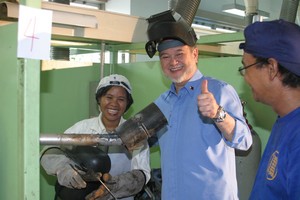
Secretary Augusto Boboy Syjuco (center)poses with a lady welder trainee and trainor at the TESDA Women’s Center in Taguig City

TESDA News and Features

Labels: , ,

Incident Report

Hanjin Subic Shipyard, Drydock No. 5, January 18, 2008 11am : Explosion was heard at the Propeller Alley (This is a compartment at the AFT, STERN, or TAIL portion of the ship)

Fatalities:

Jeremias Adamos – Barretto, Olongapo ( Family from Subic)
Mario Laxamana – Morong, Bataan

Injured:

Jonathan Martinez – Banicain, Olongapo
Gilbert Ruba – Kalalake, Olongapo (from Tarlac)
Donald Elijan – Castillejos, Zambales (All 3 confined at St. Jude Hospital)
1 Korean National and another Filipino w/ minor hand injury.
Many Filipino co-workers were traumatized by the incident.

According to the survivors:

They are working at the rudder and propeller section of the ship: fitting-cutting-welding-grinding inside a closed compartment.

Adamos and Laxamana are working (grinding) overhead, 10 to 12 feet above them.

Martinez and Ruba noticed that there are oil spills on the deck which came from the cleaning operation on the propeller.

The survivors believe that sparks from cutting and grinding operation which fell on the oil started the fire.

Other witness accounts however claimed that the sparks actually fell on the acetylene gas rubber hose.

The punctures on the hose created by hot molten metals caused the flammable gas to leak.

This gas leak, built-up in the propeller-alley compartment during their 10am breaktime.

When they returned for work at 11am, the compartment is already saturated by a highly combustible gas. An accident waiting to happen.

A spark from either welding, grinding or cutting operation ignited the combustible gas which caused the explosion and the fire.

Comments/Recommendations:

• There was no Safety Officer and/or “Fire Watch” in the vicinity while the work was going on.
• The Safety Officer should have conducted “Gas-Free Inspection” prior to start of work.
• Shipyard workers should be alert all the time, keeping their area clean and clear of hazards. The fatalities were not able to escape the fire because their bodies were entangled in the electrical wires (temporary lighting & extension cords) which were not properly organized inside the compartment.


FINAL ANALYSIS:

Since the survivors insisted that the flame actually started from the oily surface of the deck and that they have not smelled traces of combustible gas in the compartment (which would have alerted them when they returned to work after breaktime), this means that oxygen was the gas that leaked.

An oxygen-rich environment would make an ordinary oil highly-flammable.

Possible Causes of this situation are:

1. Defective Oxygen Valve.

2. Somebody deliberately opened the oxygen valve in order to introduce fresh air into the closed compartment or to flush-out smoke from welding operation (A big mistake by untrained personnel).

3. The oxygen rubber hose was accidentally punctured either by hot molten metal from welding sparks or had been mechanically damaged when hit by a sharp/heavy metal/plate.

RE-TRAINING IN SHIPYARD SAFETY IS OBVIOUSLY IN ORDER.

The writer, Olongapo Skills Training Director, Edwin Piano, have more than 20 years of shipyard experience both locally and overseas. He conducts Safety Training for welders endorsed by Mayor James "Bong" Gordon, Jr to Hanjin shipbuilding project.

Labels: , , ,

Monday, January 14, 2008

why it is very difficult to find welders?

THE VIEW FROM THE PALACE
By Ignacio Bunye

Have you ever wondered why it is very difficult to find welders?

The simple reason is that thousands of our best welders are now employed by Hanjin shipyards in Redondo Peninsula in Zambales. The fourth largest shipbuilding facility in the world expects to build 60 ships a year, 5 ships a month, and that requires a lot of welders. And we are just talking of Zambales. Wait till Hanjin opens its shipbuilding facility in Cagayan de Oro City. This week, President Arroyo witnessed the signing of a Memorandum of Understanding between Hanjin Heavy Industries and the Phividec Industrial Authority for the construction of a $2 Billion shipbuilding complex.

TESDA will have its hands full trying to train the manpower needed for such huge complex let alone supply the needs of the construction industry.

Labels: , , ,

Thursday, December 20, 2007

JOBS IN AUSTRALIA

TV Patrol World reported that 250,000 jobs are available in Australia where Filipinos can apply. Watch the video clip after the jump.
Recruitment agency MAB international Services Inc. (Mabis) and some of its partner-employers from Australia have agreed to stop the collection of fees from Australia-bound Filipino workers. Interested applicant can check out their web site at http://mabis-inc.com/index.php or you can submit a CD or Floopy Disk containing their well-detailed Curriculum Vitae and other credentials to 2nd Floor, AMO Bldg., 92 New York St., Cubao, Quezon City.
Hi, 2 all those whose interested regarding in the job open in australia, yes, australia need 250,000 workers not our agency needing 250,000 applicants. As a matter of fact some of the authorized agency may evaluate to or get some applicants carrying some oppotunities to deploy in the said country. For those who submitting their resume online, we evaluate first for some information regarding to the position they are applying for, after that, we have to pass they CV’s to the employer for final interview, if they qualified, thats the time were able to call the qualified applicants. So far from now we have no idea for the schedule of interview, yet, the opportunity becomes long term.

for the evaluation fo the resume online or walk-in, the requirements are:

FOR PROFESSIONAL APPLICANTS

- Below 45 years old (Ideally 42 years old Below)
- Bachelor / Degree Holder
- PRC License, if applicable
- MUST HAVE At least Minimum of 3 years relevant work experience (In ANY POSITION)
- Got a score of at least 7 in IELTS Academic Test or 6.5 in Reading and Listening, 7 in Writing and Speaking (for Registered Nurses and Hospital/Retail Pharmacists)
- Applicants without IELTS must wait for the go signal of the Employer to take the IELTS EXAM if they are qualified

FOR SKILLED WORKERS

- Below 45 years old (Ideally 42 years old Below)
- At least Vocational Graduate / TESDA Certificate
- Hold a Practice / Training Certificate and at least 4.5 in IELTS General Test
- MUST HAVE At least Minimum of 3 years relevant work experience (In ANY POSITION)
- Applicants without IELTS must wait for the go signal of the Employer to take the IELTS EXAM if they are qualified


Rei Says:
September 5th, 2007 at 10:29 pm Hi all,I’ve just read the article about the 250 000 jobs here in Australia. I live in Sydney and have been here since 1989. There’s heaps of Filipinos living here, and also in Melbourne.Australia has big demand right now for:- accountants/finance- factory workers- NURSES!! - absolutely guaranteed… also other health/medical positions- building and construction- engineering- trades specially WELDERS


and for those who have other experience:- Fruit picking, farm work and seasonal work- Hospitality and food service jobs- Retail jobs- Temporary administration and secretarial jobs
The labour environment here has pretty good working conditions. I would say fair and workers rights are highly protected. Good luck!
http://tagpuan.com/250000-jobs-in-australia-for-filipinos/

Labels: , ,

Tuesday, November 27, 2007

Hanjin to invest $2b more


By Joyce Pangco Pañares - Manila Standard Today

Korea’s Hanjin Heavy Industries and Construction Corp. will invest $2 billion in a new shipyard complex in Mindanao, its second in the Philippines after putting up a similar facility in Subic last year.

President Gloria Macapagal Arroyo met with Hanjin president Jeong Sup Shim at the Palace yesterday where she was informed of the latest investment in Misamis Oriental.

The money committed by Hanjin in Mindanao surpasses its capital inflow in Subic last year, which made Korea the single-biggest source of foreign direct investment in 2006.

Presidential Management Staff head Cerge Remonde said the Mindanao shipyard would be two times bigger than the complex of Hanjin in Subic.

The new facility will be constructed at the 3,000-hectare Phividec Industrial Estate in the towns of Tagoloan and Villanueva.

“The construction of general manufacturing plant of the shipbuilding facility would start early next year,” Jeong told the President.

Jeong said the plant would start fabricating ships by 2010 and was expected to export some $1.7 billion worth of shipbuilding parts and vessels two years later.

“Hanjin’s Mindanao plant would employ about 30,000 Filipinos, particularly engineers, welders, and steel fabricators,” Jeong added.

Hanjin’s Subic project is expected to generate at least $3.6 billion in annual sales with a yearly construction capacity of 60 ships worth $60 million each.

The biggest shipping vessel in the world, a $150-million floating mammoth, is currently being constructed in Subic. The vessel is expected to be bigger than the 260,851-ton Seawise Giant, which also goes by the name Jahre Viking.

Hanjin also opened a $40-million training center for shipyard workers in Subic. Hanjin has already employed some 2,400 Filipinos for its drydock construction, and is expected to hire 30,000 more in the next five years.

The President earlier created an inter-agency committee that will formulate a comprehensive five-year development plan for the ship building sector to attract more investors like Hanjin.

Mrs. Arroyo signed Executive Order No. 588 creating the ad hoc committee that will be headed by the Maritime Industry Authority.

“The accelerated and sustained development of the ship building and ship repair sector requires the joint and active collaboration between the government and the private sector as shown by even the most developed countries in the world,” the President said.

“There is a need to attract and maintain much-needed investments for the development of shipbuilding and ship repair sector in view of its capacity to contribute to the country’s economic output and its potential to open up vast opportunities for employment and skills training for Filipinos,” she added.

Labels: , ,

Monday, October 01, 2007

From accountant to welder

TALES OF THE CITY
Dramatic career shift: From accountant to welder


By Kenneth del Rosario - Inquirer
Alpha Dasmariñas wanted to work abroad because her job as an accountant bored her.

Wanting a more challenging and unique job, she went back to school to study.

A strong advocate of women empowerment, Dasmariñas, 32, took up the challenge, taking a recourse often perceived as a man’s job.

Not caring if she would be tagged as “one of the boys”, she enrolled at the Labor-Link Technical Institute (Labor-Link), the first welding school in Quezon City put up to produce globally competitive welders.

“We had women, out-of-school youths and senior citizens in mind when we first thought of this project,” said Bernadette Herrera-Dy, a Quezon City councilor and founder of the Bagong Henerasyon (BH) Foundation, the organization that helped put up Labor-Link last February to provide employment opportunities for the city’s residents.

BH Foundation, created in 2002, coordinates efforts to tap potential workforce and develop people’s skills. Dy said they were aware of the strong demand for male and female welders alike, and realized they could provide a steady supply only if there was a venue where people could get formal training in the trade.

Dasmariñas, who graduated last June, will start working as a welder for a real estate company in Makati City in a couple of weeks. “After getting experience here, I would definitely want to go abroad, too,” she said.

According to Dy, Dasmariñas is only one of at least 50,000 welders in demand in and out of the country today.

Since the organization put up the welding school, the foundation has produced at least 280 graduates, 40 of whom are already working abroad. The organization either supports or helps students get sponsors for their studies or facilitates scholarship grants from the Technical Education and Skills Development Authority (TESDA).

Apart from being the pioneer welding school in the city, Labor-Link, located in Balintawak, Quezon City, also boasts of a big number of women students enrolled in the course alongside their male counterparts.

“The response has been overwhelming,” the councilor told the Philippine Daily Inquirer, parent company of INQUIRER.net. “High school graduates who never had the chance to continue their education can now do so with this program.”

She added that even people who have not been able to go to school or those with no experience in welding can enroll as long as they show a genuine interest in learning the trade. Even people who already know how to weld but had no formal training can also enroll to get technical training, she said.

Dy noted that when they opened the welding school in February, there were only three female students out of 40 who enrolled. Today, she said, there are about 50 female students out of the 180 who signed up for the course.

“This is for the women, so I’m happy that we are seeing more female enrollees in school,” she said. “But this does not mean we’re discouraging men to enroll. They’re very welcome to join.”

Female welders are actually more preferred than males abroad, said Carlo Dimayuga III, president of Labor-Link. “This is because women have ‘lighter’ hands and more flexible wrists that tend to produce more polished work,” he added.

He noted that women welders are also generally more patient than men so foreign companies prefer to hire them, especially for jobs that require extensive attention to intricate details.

Gene Madridano, one of the four instructors in the welding school, noticed that his female students are definitely at par, if not better, than his male students. “They’re not just good at the application part, they’re also good in the lecture portion. Men sometimes are not as focused in this area,” he said.

Dimayuga said that this early, companies from Korea, Japan, Canada, New Zealand, Australia and Taiwan, among others, have expressed interest in hiring their female graduates.

The basic course Shield Metal Arc Welding (SMAW) lasts for a total of 38 days or 304 hours, Carlo said. Classes are held from Mondays to Saturdays, 8 a.m. to 5 p.m. Students then have the option to take the next more advanced course called Gas Metal Arc Welding (GMAW).

The students who enroll in the program, Dimayuga pointed out, have to pay “virtually nothing” because everything is shouldered by TESDA. The course, for walk-ins or those who do not have scholarships, on the other hand, costs from P10,000 to P15,000.

Welders who graduate from Labor-Link are ready for hiring in any shipping, pipeline, real estate and construction company anywhere in the world, Madridano said.

According to Dasmariñas, “I am proud to be a welder. This is now my life. Years from now, I will come back here after gaining valuable experience abroad. Who knows, I may even start a welding business or put up my own welding school.”


QUEZON CITY Councilor Bernadette Herrera-Dy (center) and Carlo Dimayuga III (third from left), Labor-Link president, check out a student’s welding skills. AUGUST DELA CRUZ

Labels: , , , , ,

Saturday, January 20, 2007

Shipyard Diary of a Woman Welder

Sunday I am back from my first day on the Ways [staging on which ships are built], and I feel as if I had seen some giant phenomenon. It's incredible! It's in-human! It's horrible! And it's marvelous! I don't believe a blitz could be noisier-I didn't dream that there could be so much noise, anywhere. My ears are still ringing like high-tension wires, and my head buzzes. When you first see it, when you look down Way after Way, when you see the thousands each going about his own business and seeming to know what to do, you're so bewildered you can't see anything or make sense out of it. First came the bus ride to the Yard.
Crowded as usual. I was intrigued by knowing that this time I was going to Mart's Marsh. The name has al-ways fascinated me. I gather that it refers to bottom or marshy land once owned by a family named Mart. From the [welding] school our road led along the water where I could see several of the ships already launched and now lying at the outfitting dock to receive the finishing touches. It was easy to spot the various stages of completion; each ship gets moved up one when a new ship arrives for outfitting. When the bus came to a stop, I followed the crowd across a pontoon bridge between rails at which stood guards checking for badges. The far side of the bridge brought us to the part of the Yard where the prefabricated parts are stored, right in the open, pile upon pile. I saw a huge building marked "Assembly Shop," another "Marine Shop," and still another "Pipe Assembly."
There were lots of little houses marked with numbers. Most of them seemed to be in the sixties. And I was looking for check-in station No. 1. I hunted and hunted without success, and finally asked someone where "new hires" check in. He immediately directed me. I showed my badge, told my number, and was given another badge to be picked up and turned in daily as we did at school. It was marked "New Hire." About then who should come along but Red-headed Marie and the Big Swede! We went together to the Welders' Office where our off days were assigned to us. I was given "C" day and told that it was the only day available. This means that I get Tuesday off this week, Wednesday next, and so on. The Big Swede said she had to have "D" day to get a ride to work and to have the same day as her husband. Although "C" day was "the only one available," strangely enough she was given "D" day. One has to learn to insist on what one wants even when told it is impossible.

The Big Swede is a real pal. She had not forgotten the patch for my overall trouser leg. She had cut a piece from an old pair of her husband's, scrubbed it to get the oil out, and brought it to me with a needle stuck in the center and a coil of black thread ready for action. "Here," she said, "I knew you wouldn't have things handy in a hotel room. Now you mend that hole before you catch your foot in it and fall." . . . Today my book on welding came from the Washington office.
I read that a welder's qualifications are "physical fitness which insures a reason-able degree of endurance during a full day of work; steady nerves and considerable muscular strength." For a shipyard welder I'd amend that to read: "An unreasonable degree of endurance during a full day of strain, plus muscular strength, plus no nerves." If you haven't the muscular strength before you start, you will have it afterward. If you haven't the nerves before, you may have them afterward, though I doubt it. By tomorrow I shall be "reasonably" acclimated, but tonight I quite frankly "ain't." I, who hate heights, climbed stair after stair after stair till I thought I must be close to the sun. I stopped on the top deck.
I, who hate confined spaces, went through narrow corridors, stumbling my way over rubber-coats leads-dozens of them, scores of them, even hundreds of them. I went into a room about four feet by ten where two shipfitters, a shipfitter's helper, a chipper, and I all worked. I welded in the poop deck lying on the floor while another welder spattered sparks from the ceiling and chippers like giant woodpeckers shattered our eardrums.
1, who've taken welding, and have sat at a bench welding flat and vertical plates, was told to weld braces along a baseboard below a door opening. On these a heavy steel door was braced while it was hung to a fine degree of accuracy. I welded more braces along the side, and along the top. I did overhead welding, horizontal, flat, vertical. I welded around curved hinges which were placed so close to the side wall that I had to bend my rod in a curve to get it in. I made some good welds and some frightful ones. But now a door in the poop deck of an oil tanker is hanging, four feet by six of solid steel, by my welds. Pretty exciting!
The men in the poop deck were nice to me. The shipfitter was toothless. The grinder had palsy, I guess, for his hands shook pitifully and yet he managed to handle that thirty-pound grinder. The welder was doing "pick-up" work, which meant touching up spots that had been missed. An inspector came through and marked places to chip, and the ship's superintendent stopped and woke the shipfitter's helper.... As a result of all this, I feel very strongly that we'd go to the Yard better prepared if in the school we did more welding in varied positions. Even a fillet weld of two plates could be placed on the floor, and one could get down and do it there and so learn something of what will later be required in the Yard.
I don't see why, too, the butterflies, the clips, and even the bolts couldn't be welded at various angles in school. We could practice some one-handed welding instead of always using two hands while sitting at a bench with plates conveniently placed. There are times when you have to use one hand to cling to a ladder or a beam while you weld with the other. I notice that the most experienced welders I have watched seldom use two hands. One large, fine-looking woman (Norwegian, I think) who has been there three months told me: "They don't teach us enough at school. Why don't they let us weld there the same things we'll do here?" I countered with, "Oh, they do teach a lot or we'd be no good here at all; but what you say would certainly help." I think she "has something," however.
We do need more experience in setting our machines and recognizing when they are too hot or too cold. Struggling with an inaccurate setting and the wrong amount of heat makes a harder day than doing a lot of actual work. Yet it's hardly the fault of the training that we lack adequate experience. More and more I marvel at training that in eight days can give enough to make us worth any-thing on the job. And we are worth something. We're building ships.


SOURCE: From Shipyard Diary of a Woman Welder by Augusta H. Clawson, illustrated by Boris Givotovsky. Copyright 1944 by Penguin Books, Inc.

Labels: , ,